


This story is the first in a two-part series on community-controlled commercial real estate projects scaling up through new partnerships and relationships. This coverage was produced in collaboration with Next City, a nonprofit news organization that believes journalists have the power to amplify solutions and spread workable ideas from one city to the next city.
For years, the Globeville Elyria-Swansea Coalition in Denver has had its eyes on a 2.68-acre former used car lot at 4965 Washington Street, on the southwest corner at the intersection with 50th Avenue.
The dormant lot sits at the heart of an industrial area in Denver’s Globeville neighborhood, surrounded by meatpackers, fruit and vegetable wholesalers, metal fabricators, auto repair shops and tire shops — the kinds of employers that drew largely Latino working-class families to the neighborhood in the first place. They may not always be the most well-paid or safest jobs, but they were steady jobs and many could walk to work from their small single-family homes nearby.
Denver has seen a flood of new development over the past decade. Many of the legacy industrial businesses that remain in Globeville are facing pressure from developers who are thirsty for their large lots — perfect for those stereotypical, blocky, “5-over-1” market-rate apartment buildings popping up all over Denver, Salt Lake City, Phoenix and other fast-growing cities across the country.
But now the used car lot at 4965 Washington is on a path toward a different future, as part of a community land trust that the coalition incubated. The project will soon break ground as a 253,000 square-foot, mixed-use development with 170 permanently-affordable housing units above a ground floor featuring a new public library as well as a cafe, commercial kitchen and community hub.
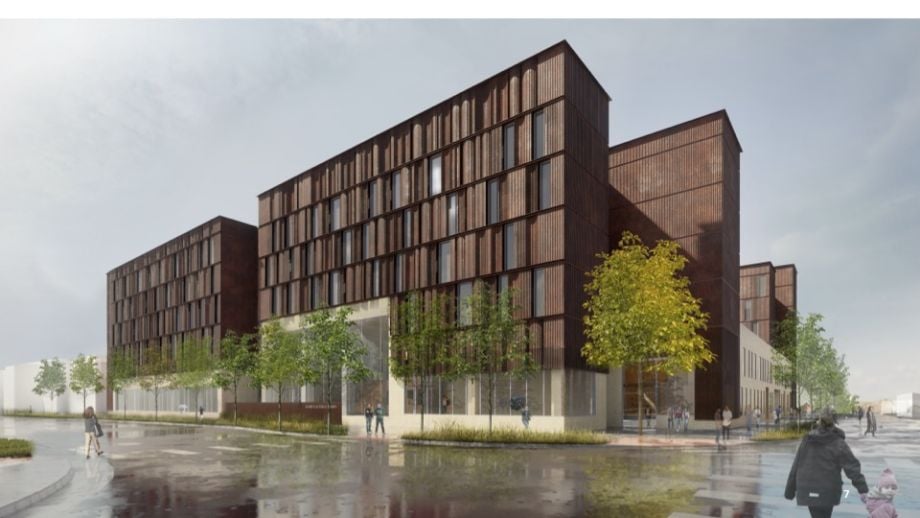
The Globeville Elyria-Swansea Coalition hopes 4965 Washington can serve as a beacon for the city to see the community as a valuable partner in larger-scale development — instead of just passive recipients of community benefit promises that are never fully realized, or as collateral damage from creative destruction for the sake of boosting property values, tax revenue, profits and ego.
“This is really setting us up for partnering with the city in a lot of ways,” says Nola Miguel, executive director at the coalition. “That’s exactly the type of thing that we’re planning on, that we’re kind of building up to, and we have been meeting with impact investors and looking for types of investment that a typical developer isn’t going to be able to access or isn’t even really aware of.”
Community power in economic development
Models for community ownership and control of commercial and mixed-use real estate have been quietly gaining momentum across the country.
In Philly, the Kensington Corridor Trust has acquired 31 commercial, mixed-use and other properties and counting in its portfolio since inception in 2019.
Based in Atlanta, The Guild is nearly finished construction of its first mixed-use development under community ownership and control, in the city’s predominantly-Black Capitol View neighborhood.
The entrepreneur collective E.G. Woode is in the middle of renovating the second building in its portfolio on the South Side of Chicago. It’s helped inspire a wave of community-owned commercial real estate projects now emerging across the city.
Oakland’s East Bay Permanent Real Estate Cooperative is quietly making progress on its restoration, re-envisioning and expansion of the historic blues and jazz club Esther’s Orbit Room, now planned as an anchor for an entire culture-driven revitalization of the city’s historic 7th Street corridor.
Some of these examples are cooperatives, whose members include the occupants of the buildings as well as members of the surrounding community and investors. Others, like in Kensington, have created perpetual purpose trusts as another form of intentionally structured community control over real estate.
Community land trusts have historic roots in broader uses for agriculture and commerce, though they are more commonly seen these days as models for creating and preserving affordable housing. In St. Paul, after decades focused on housing, Rondo Community Land Trust has spent the last few years acquiring or developing commercial and mixed-use properties as part of its vision to revitalize the Selby Avenue Corridor.
While the exact shapes and forms differ, a few common threads run through all these examples. Strong roots in or reliance on community organizing. A belief that the prevailing model for real estate development — based on outsiders buying low and selling or renting high to maximize profits for themselves — doesn’t work for the communities where these models are emerging. A desire to bring ownership and control over storefronts, cultural landmark venues, creative spaces and other shared spaces back to the surrounding communities.
Each of these models also has some kind of intentional decision-making structure, open and transparent to community voices, often designed collectively with or by community members.
“When we started our commercial community land trust work, it was in response to community members who wanted less expensive leasing options because they were being displaced out of their business spaces,” says Mikeya Griffin, executive director at Rondo Community Land Trust and fourth-generation member of the Rondo community in St. Paul.
“We are doing everything from housing to economic development, and that includes cultural place keeping, because we have to — it’s providing a sense of healing and it’s also an economic driver for communities. When we think about community development it’s really taking that in a holistic approach, in a place-based, community-led fashion.”
Community ownership
The Globeville and Elyria-Swansea neighborhoods surround the National Western Center, home to a major annual livestock show that takes place every January, going back to 1906. In 2015, Denver City Council approved a new master plan calling for the expansion of the facility into a year-round hub for entertainment and education. The Globeville Elyria-Swansea Coalition came together that same year, as residents and local businesses grew concerned that the city’s plans would displace them from their neighborhoods.
In 2018, the city itself used eminent domain to seize five properties, four commercial and one residential, part of a larger set of city acquisitions in the area to make way for the National Western Center expansion. Further real estate speculation started happening nearby, with investors looking to capitalize on the city’s plans. Against that backdrop, the coalition formed Tierra Colectiva Community Land Trust to fight back by taking land off of the speculative market, placing it in service to the community for good.
“We chose a land trust structure really for community control overall,” Miguel says. “Thinking about how to control development in the long term was definitely always the purpose. We started with home ownership because that was the biggest need at the time, so that was the first priority, but commercial and open space have always been a piece of the vision.”
Since inception, Tierra Colectiva Community Land Trust has developed 14 units of permanently-affordable low-income homes, with 23 more in the pipeline. It also recently acquired a 10,000-square foot open lot that it’s now turning into a food forest.
The former used car lot at 4965 Washington Street was one of many properties that the Globeville Elyria-Swansea Coalition started organizing around for acquisition as part of Tierra Colectiva Community Land Trust. As a new land trust, it couldn’t make all those acquisitions by itself, especially a larger lot like this one. The coalition started pushing the city to acquire the property, which it did in 2018.
The city used federal Community Development Block Grant funding to pay the private owner $6 million for the 4965 Washington Street site. The coalition followed up by organizing residents to provide community input that helped shape what the city eventually put out in its request for proposals to redevelop the site.
_920_518_80.jpeg)
“We were pushing for lower AMI levels, having larger family units with three and four bedrooms, a library on the first floor, along with additional commercial space,” says Nola Miguel, executive director at the GES Coalition.
“All those things ended up in the [request for proposals]. And so we thought, let’s actually not just influence the RFP, but actually be part of the development team that applies.”
Tierra Colectiva actually joined two competing developer teams that submitted responses to the city-led RFP for the former used car lot. The city chose one of them, a proposal led by Chicago-based Evergreen Real Estate Group. Under the winning joint venture proposal with Evergreen, however, Tierra Colectiva only had a 1% ownership stake in the overall project.
In a typical community land trust setup, the trust holds the deed to the land while extending a long-term (usually 99-year) ground lease to the homeowner or business who lives or operates within the structure on top of the land. That wasn’t an option with the former used car lot.
The city decided it would retain ownership of the land while extending a 99-year ground lease to the joint venture of Evergreen and Tierra Colectiva — a common practice for any city-owned property offered up for development, not just in Denver. The city is charging the joint venture a nominal $10 a year in rent.
“It’s a little disappointing,” Miguel says. “But it’s still holding the 99 year land-lease, it still has all the things we wanted, especially maintaining the affordability long-term.”
On top of the library and the commercial space, the 170 residential units will be targeted for a range of households from 30% to 80% of area median income, half of the units will be 3-bedroom or 4-bedroom units, and 20 of the units will be permanent supportive housing.
But that 1% of ownership in the project still didn’t feel like enough to the land trust’s members. Tierra Colectiva went back to Evergreen. They worked out a deal for the land trust to carve out a commercial condominium to take additional ownership of the project’s ground floor commercial and community space, totalling nearly 4,000 square-feet.
“We were kind of problem-solving a little bit because we weren’t super happy with the amount of ownership that we had overall,” Miguel says. “We landed on the commercial space as a way to hold community ownership, having an ongoing presence where we can do tenant organizing, building a commercial kitchen so it’ll have micro entrepreneurs from the neighborhood, and keeping that neighborhood presence and activity not only for tenants but for residents at large in the community.”
Relationships rooted in community power
The Globeville Elyria-Swansea Coalition had leverage when it went in to negotiate that extra bit of community ownership over the commercial space at 4965 Washington. It went with investor dollars to back them up.
Formed in 1995, the Colorado Health Foundation is one of 300-plus health conversion foundations across the country that formed after a for-profit hospital system acquired a nonprofit or public hospital or hospital system. A portion of the hospital system sale proceeds gets set aside into a portfolio of income-producing investments that fund grants made in support of the health conversion foundation’s mission.
While they generally have some kind of health-related focus, the exact mission, grantmaking and even investment strategies of health foundations have the ability to evolve over time. More and more health foundations have moved into supporting housing, for example, on the basis that secure and affordable housing is a key social determinant of health.
Support for housing can take on many forms. The Colorado Health Foundation first started actively supporting housing about a decade ago, mostly by providing below-market financing, often as part of deals funded mainly through federal low-income housing tax credits.
As the foundation continued exploring the affordable housing landscape in Denver and around Colorado, the city-led National Western Center redevelopment was heating up. The Globeville and Elyria-Swansea Coalition was becoming harder to ignore. Over the course of one-on-one conversations, walking tours, tree plantings and other volunteer events around their neighborhoods, coalition members found every opportunity to talk with anyone and everyone about what they could see for their community’s future.
The Colorado Health Foundation was among the first major funders to ask the coalition what they could do together. It started with multi-year operating support for community organizing around anti-displacement — like in 2021, when the Globeville Elyria-Swansea Coalition spearheaded a campaign to defeat a citywide ballot initiative that would have approved a new arena as part of the National Western Center.
The Colorado Health Foundation eventually started providing support for Tierra Colectiva Community Land Trust to acquire properties and start building homes. It started with a $600,000 grant to support the land trust’s first multifamily project. Board members from the foundation have gone on tours with the coalition, meeting the residents who make up its membership.
“We were able to set them in front of members throughout different parts of the community,” Miguel says. “We went to the actual 4965 Washington site and talked with a bunch of Globeville residents. That definitely was a shifting point.”
In support of the 4965 Washington project, the Colorado Health Foundation is chipping in with $6 million — a combined $3.5 million in a low interest loan to support the housing component of the project and a $2.5 million grant to the land trust to support the commercial condo acquisition. It’s the Colorado Health Foundation’s largest single investment to a project yet, and one of several recent investments in community-controlled real estate efforts around Denver that the foundation has made recently.
“They’re looking for projects like this that are community-led,” Miguel says. “That seems really different to me than other foundations. I think other foundations are getting there, but they’re still thinking about scale for scale’s sake, instead of the deep type of impact that you can have with community ownership.”
The Colorado Health Foundation hopes others will take a page from their book.
“The Foundation’s investment in this project reflects our mission to foster innovative solutions that bridge the challenges of housing, health and community well-being,” Tracey Stewart, senior program officer at the Colorado Health Foundation, said in a statement. “We are excited to watch this development take shape and hope that it will inspire other foundations and those working in the affordable housing space to support housing justice through community-driven development.”
What’s next?
The project at 4965 Washington served as a kind of proving ground for the community to come together around a vision for developing a larger parcel. At beloved neighborhood businesses like Panaderia Emmanuel, the coalition held meetings to discuss ideas for the dormant lot, generating the feedback that went into the RFP. That in turn informed the winning proposal, which the community is soon to see manifested in real life.
There’s already at least one opportunity on the horizon for that to happen again, and on an even larger scale.
The city’s expansion plans for the National Western Center include 45 acres of city-owned land, including the five lots acquired through eminent domain back in 2018. Under the city’s original master plan, it was to select a large private sector partner to serve as a master developer for the 45 acres — known as the “the Triangle.” Citing new economic conditions after Covid-19, the city scrapped that process in 2021.
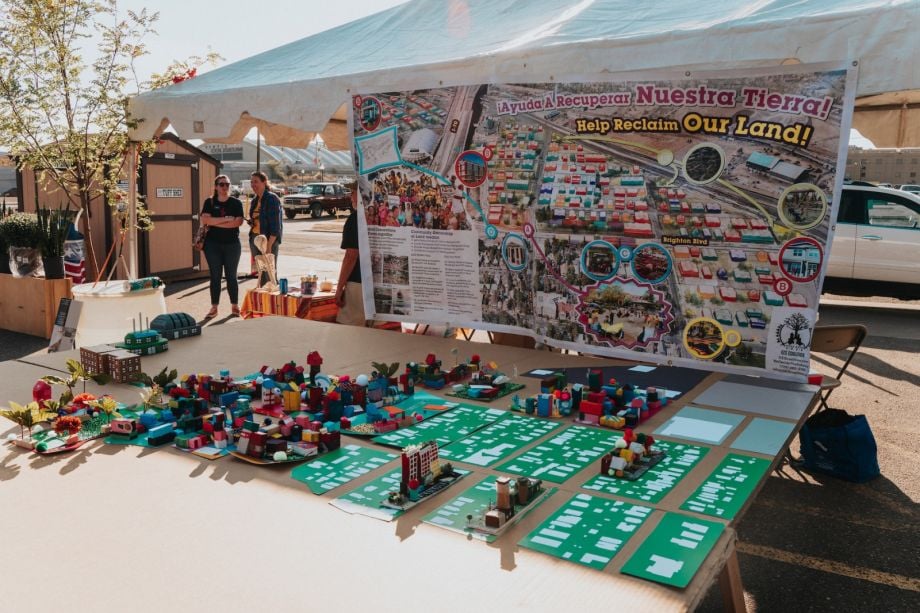
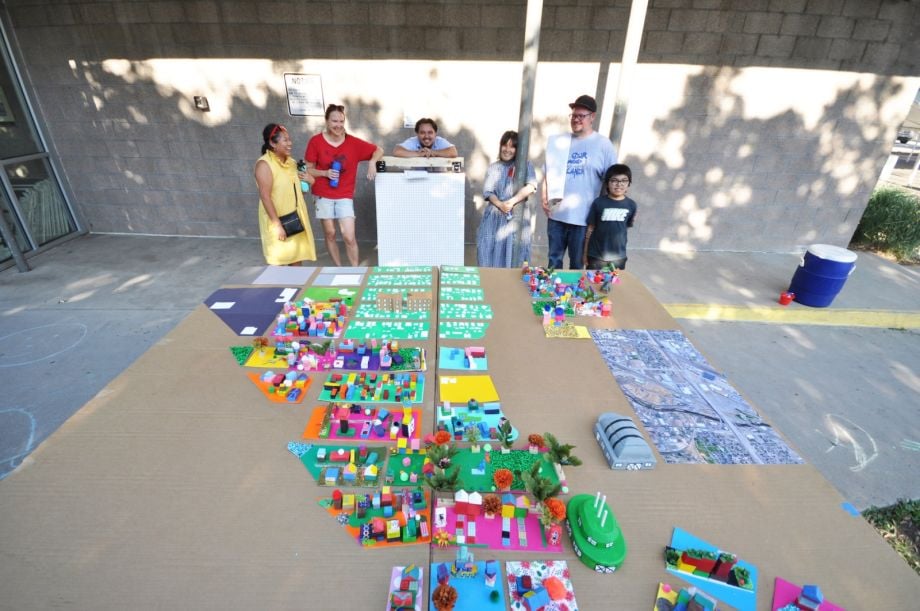
The Globeville Elyria-Swansea Coalition has been calling for the city to launch a new RFP process for the Triangle, and this time take into account the community vision it has been discussing at community events and elsewhere around their neighborhoods. They even constructed a 3D model of the triangle to help facilitate conversations that fed into the vision they’re now pushing, which includes more housing that they can actually afford, more focus on space for local businesses and local artists, and an open plaza suitable for community gatherings, street vending, and street performances.
Could the coalition co-develop some of that housing and other projects? Even if they can’t own the land, could they shape what someone else does with it? In June 2021, the coalition organized a march from one point of the Triangle to another to rally support for their vision. They were joined by staff members from the Colorado Health Foundation.
There isn’t much precedent for community power to influence or take some form of ownership over city-led projects at the scale of the Triangle, with hundreds of millions or even billions in tax dollars at stake, both in the investments made and the future tax revenues and profits generated. Bigger projects like stadiums, arenas and sometimes even presidential libraries still mostly treat surrounding communities as passive beneficiaries of community benefit agreements.
But political leadership always has an opportunity to decide if it wants to proceed with business as usual – or choose another approach.





%20(1280%20x%20720%20px)%20(46).png)

.webp)
.webp)
%20(1280%20x%20720%20px)%20(3).webp)

%20(1280%20x%20720%20px)%20(39).png)
%20(1280%20x%20720%20px).webp)

%20(1280%20x%20720%20px)%20(2).webp)


%20(1280%20x%20720%20px)%20(40).png)


.webp)


