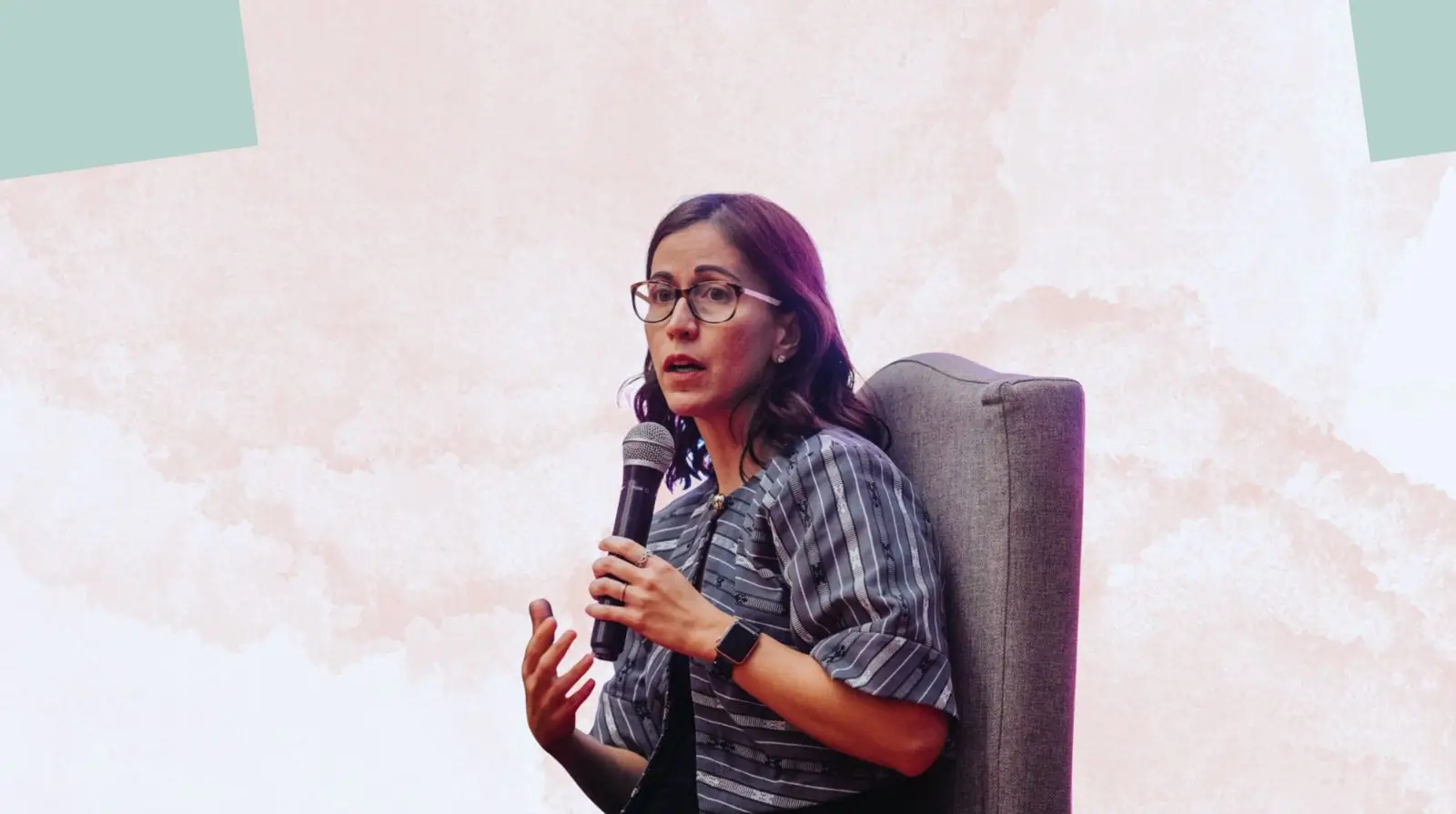

Amina Evangelista Swanepoel is the co-founder and executive director of Roots of Health/Ugat ng Kalusugan, the only reproductive health organization on the island of Palawan in the Philippines. Roots of Health uses a rights-based approach to deliver free reproductive health services to remote communities, education for adolescents, young adults and families, and system strengthening support for local government partners.
Born and raised in Manila, Ami grew up surrounded by the challenges facing young women and girls in a deeply patriarchal society as well as the opportunities unleashed by the People Power movement’s overflow of the dictatorship of Ferdinand Marcos. After completing a double Masters Degree in International Affairs and Public Health at Columbia University, Ami returned to the Philippines to co-found Roots of Health with her educator mother and a tight knit group of supporters. Sixteen years later, Roots of Health provides a holistic array of reproductive health services and its 70 community health advocates have provided almost 100,000 adolescents and young adults with comprehensive sexuality education.
Ami joined Proximate Press to discuss the challenges of growing and sustaining an organization over more than a decade and a half of evolution, adaptation, and expansion, as well as the challenges she faces leading a community-focused nonprofit in a moment of dramatic change.
Roots of Health recently celebrated its Sweet 16. What are some key milestones that have enabled you to build and continue to grow the organization over the past decade and a half?
Starting about five years ago, we’ve been able to see some of the long term impact that we've been working towards, and that is the decline of teen pregnancy in Puerto Princesa. And over the last few years, the teen pregnancy rate in the city decreased by 60%. So that was something quite major.
Roots of Health’s growth over the years has always been quite organic, and we've never kind of had a colonizers view of like, where else are we going to go next? But it was more this feeling that if we can have this success in our own context, how amazing would it be if we could do this nationally?
So from that point on, we started looking… where else we could potentially implement the programs and services or have the same kind of relationship with the local governments, and see if we could have the same kind of impact.
When we first started, our mandate was pretty clearly focused on providing sex ed in schools, and we started doing that. But we also liaised with the city health office and other government units to basically find out, what are the issues? What are your concerns? Where are the areas where we're not duplicating your services, but we're adding extra value?
And one of the things they identified was that there are a lot of communities in Palawan… where the women have very, very basic levels of education… and had never had sex ed. These women were now in families and didn't really know anything about family planning or reproductive health generally. So the city health office asked us if we could also provide the education that we were giving in schools in communities. And so of course, we agreed.
That was also the organic segue into working more closely with the government. At first we were just doing the partnerships with them for contraceptives that we could provide. But then we started doing trainings for government community health workers, for the government workers themselves, for different arms within the government, and then later for the teachers within the Department of Education.
Speaking of local government, how does Roots of Health’s evolution line up with the process of devolution in the Philippines? Do you feel the local government has now been empowered to partner with you in a different way?
It's funny, because empowered is not the word I would think of, because often when they approach us, they sound really desperate and stressed and not so empowered, but the local government has turned to us a lot more because of the fact that they are now mandated to do a lot more things, which the unfortunately reality is that they're not equipped to do.
How would you describe your relationship with funders when it comes to the substance of the work and the theory of change that underpins it?
We've been very lucky as we've expanded because we've been able to find partners where the funding is restricted – in the sense that we have to design the program and they need to sign off on it in terms of what we're going to use the money for and how we're going to deliver the services – but it's unrestricted in the sense that we get to say, this is what we need, this is how we would implement it, this is what we want to do. That is the best kind of partner for us.
In the past, we would spend a lot more time kind of getting to know the donors that we could see whose values and the way that they do their work were aligned with our approach, and so then we could kind of work with them, and they would invite us to apply.
Now we're having to apply cold to anything we see online that seems relevant, and a lot of those things are very restricted. They have these objectives. Sometimes they just say, we want to empower women through education, and then you can kind of pitch how you would do things. But sometimes it is very restrictive, especially the larger pots of funding from European nations, UN type things. It's so specific to what has to be done.
I would imagine that these entities are designing their calls for proposals with a lot of data and analysis and have an evidentiary basis. Does an evidence-based approach sometimes collide with a community-based approach in terms of what is needed and how to do it?
Yeah, definitely.
Where is that evidence coming from? What countries? Because there is so little data based in the Philippines. There is so little data on what development interventions have been done, what has worked, what is worth replicating. There's really very little that you could find. And so what if you're limiting it to evidence-based things, then we're having to fit ourselves into contexts that are not exactly ours.
You have had multi-year grants from funders, but just two-five years. Do you think the sector needs to think about their time horizons differently, or how they really partner over the long term with an organization like Roots of Health?
It's so helpful when they [funders] are able to say that we will fund you for this length of time. But even the organizations that are great at doing that aren't always able to tell you in the best way. For example, we were funded by Empower, which is an amazing organization, and they funded us for 10 years. And their 10th year is very thoughtful. Their term is “your sunset year.” When we first heard it, we were like, wait, are we dying? Where are we going? Like, what is happening?
But for the sunsetting period, they increased the grant that they gave for that last year. It's completely unrestricted. The money can go towards anything. They were very thoughtful about helping us to connect to more support. So that was great, but for the first five years of that, we had to apply every year for more support, and then for the next five years, they were two-year grants, but we still had to apply. At no point did they say, You have us for 10 years.
So I think I mean the gold standard in terms of the donors that all nonprofits want are the ones who give unrestricted funds for multiple years and are upfront about how many years you can apply for. But they are so few and far between, it's really hard to find those donors.
What direction do you think private philanthropy and other investors in reproductive health need to go?
I'm generally more drawn to the donors that are interested in changing the systems, in strengthening those systems, because the USAID shutdown really shined a light on how bad the reliance on foreign donors was for so many of these organizations.
But why did those organizations exist? Because the local duty bearers weren't doing the work that they needed to do, and so of course, there's always going to be a place for organizations that deliver the direct services.
But if we're going to move away from that culture, what really needs to happen is that these governments need to be capacitated, and they need to be able to provide the basic services for their constituents.
And so for me, if I was designing, you know how the Warren Buffets of the world would use up all their money, I would definitely focus on organizations that are working to change those systems, recognizing that this change takes a long time.
Almost all of our donors over the last few years have intentionally moved into this trust based grant making and letting organizations that they trust and support make those decisions, fewer reporting requirements, just like basically letting the organizations get on with the work.
It has really made a difference. And I think that if there was a bigger move among philanthropy in general, for more of these donors to go that way, I think that it would definitely be a shift in the right direction.